
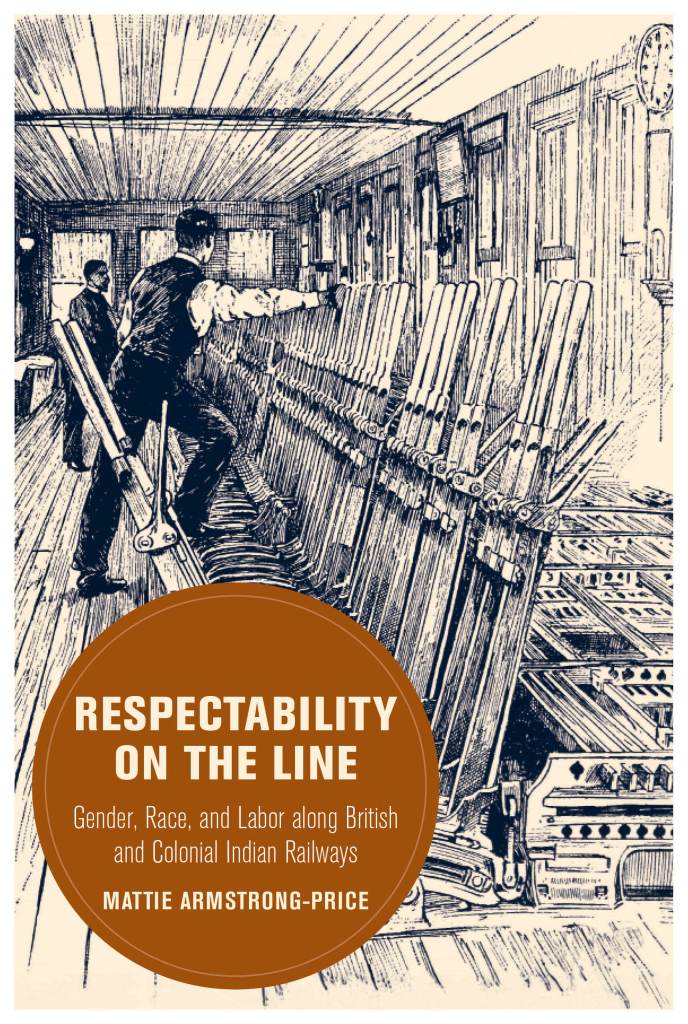
Advance Praise for Respectability on the Line:
“This remarkable study of 19th century capitalist and colonial workplace paternalism combines diverse historiographies with a dizzying range of cross-disciplinary knowledges and approaches, including literary theory, studies of affect and emotions, science and technology studies, feminist theory, and Marxism [classical and contemporary]. The result is a brilliantly executed analysis of the consequences of capitalist industrialization for particular gender regimes, patterns of social authority, modes of racialist understanding, and the rise of a liberal-imperial governing order. Mattie Armstrong-Price is that rarest of intellectuals: the historian’s historian who is simultaneously a theory head. This book is compelling confirmation that the largest-scale problems can be meticulously brought down to imaginatively conceived, empirically focused, and concretely illuminating micro-historical ground.”—Geoff Eley, author of History Made Conscious: Politics of Knowledge, Politics of the Past
“A rich, comparative history of how ideologies of labor and management shaped histories of gender and social reproduction across political and racial hierarchies. Respectability on the Line tells a compelling story about how paternalism, colonialism, and capitalism materialized in the intimate and domestic lives of railway workers to shape collective action and class formation in India and Britain.”—Ritika Prasad, author of Tracks of Change: Railways and Everyday Life in Colonial India
“This is a timely and welcome addition to history of railway labour and capitalism. Intertwining histories of metropolitan Britain and colonial India, this empirically rich narrative uses respectability as a conceptual category to understand how labour relations were shaped across railway sites.”—Aparajita Mukhopadhyay, author of Imperial Technology and ’Native’ Agency: A Social History of Railways in Colonial India, 1850-1920
“Armstrong-Price brilliantly reshapes labor history to show a gendered and racialized tradition of paternalism operating in imperial and metropolitan spaces of the Victorian state, where managers cultivated respectability, workers stretched the parameters of respectability in non-heteronormative ways, and local workers turned to Indian nationalist leaders to denounce the fictions of this respectable paternalism and expose discrimination.”–Judith Walkowitz, author of Nights Out: Life in Cosmopolitan London
Publications
- Curriculum Vitae
- Synopsis of second book project: Laboring in Public
- “Risk Management,” in University Keywords, ed. Andy Hines (Johns Hopkins University Press, 2025).
- “The Wooden Brain: Organizing Untimeliness in Marx’s Capital,” in Mediations 30:3 (Fall 2017).
- “Looting: A Colonial Genealogy of the Contemporary Idea,” in Postmodern Culture 27:1 (September 2016).
- “Adjacent Histories: Reading Riley’s Am I That Name? Against Contemporary Debates in Feminism,” with Julie Beth Napolin, History of the Present 11:2 (Oct 2021), 209-222.
- “Certificates of Live Birth and Dead Names: On the Subject of Recent Anti-Trans Legislation,” in South Atlantic Quarterly 116:3 (July 2017), 621-631.
- “States of Indebtedness: Care Work in the Struggle Against Educational Privatization,” in South Atlantic Quarterly 110:2 (Spring 2011), 546-552.
Reviews
- Review of Carolyn W. de la L. Oulton’s Down from London: Seaside Reading in the Railway Age (Liverpool UP, 2022), for Nineteenth-Century Contexts 45:3 (2023).
- “Missing Pieces: A Review of Colin Barker, Gareth Dale, and Neil Davidson’s Revolutionary Rehearsals in the Neoliberal Age,” Spectre Journal (Fall 2021).
- “Disarticulating the Mass Picket,” Review of Joshua Clover, Riot. Strike. Riot. (Verso, 2016), for Viewpoint Magazine (September 2016).

 Mattie Armstrong-Price